
 MENU
MENU 

Scientific Milestone: A room temperature Bose-Einstein condensate
A BEC is an unusual state of matter in which a group of boson particles can exist in a single quantum state, allowing scientists to observe novel quantum phenomena.

 Enlarge
Prof. Pallab Bhattacharya and a team of researchers have created and directly observed what they believe to be a near-equilibrium room temperature Bose-Einstein condensate (BEC). A BEC is an unusual state of matter in which a group of boson particles can exist in a single quantum state, giving scientists the rare opportunity to directly observe novel quantum phenomena. A boson is a fundamental particle in nature having properties distinctly different from electrons. Photons are also bosons.
Though theorized by Satyendra Bose and Albert Einstein in the mid 1920’s, the first BEC was observed in 1995, and it required cooling rubidium atoms to temperatures close to absolute zero. A combination of laser cooling of the atoms, magnetic trapping, and further evaporative cooling was required to reach this temperature.
Prof. Bhattacharya and his group recently demonstrated that using quasi-particles called polaritons, which are bosons, it is possible to observe a BEC at room temperature.
A paper on the research is published in Proceedings of the National Academy of Sciences.
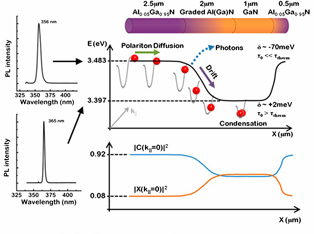
“Our experiment was done with a very thin wire – a nanowire – made of aluminum (Al), gallium (Ga) and nitrogen (N),” explained Prof. Bhattacharya. “Thus it is an alloy (AlGaN) nanowire, but with varying amounts of Al and Ga along its length to form a trap in a small section of the nanowire where there was no aluminum.
The researchers buried the nanowire in a bowl-shaped, reflective device called a dielectric resonant cavity. Then they shined light on the nanowire to excite particles where there was a high content of aluminum. The light reflecting in the cavity coupled with exciton particles in the nanowire (an exciton is an electron bound to a “hole,” or place where an electron used to be).
 Enlarge
Together the photons and excitons produced polaritons. These polaritons then diffused and drifted towards the trap in the nanowire.
“As the polaritons moved along the nanowire, the ones with the highest energy exited the cavity as light, enabling evaporative cooling and ensuring that the coldest polaritons reached the bottom of the trap to form a near-equilibrium BEC at room temperature,” Bhattacharya continued.
Prof. Bhattacharya believes this to be a significant scientific achievement that will allow other scientists and researchers to more easily pursue as-yet unknown avenues of research afforded by room temperature BEC’s. Specifically, he states that because the polariton BEC is a coherent state of matter, it is possible that the light emitted can one day be controlled and used for sensitive instrumentation and measurements.
 Enlarge
This research was conducted as part of the NSF Center for Photonic and Multicscale Nanomaterials (C-PHOM), directed by Prof. Ted Norris. Prof. Bhattacharya leads one of the two primary thrusts, called the Wide Bandgap Nanostructured Materials for Quantum Light Emitters. C-PHOM will develop high-tech materials that manipulate light in new ways. The research could enable advances such as invisibility cloaks, nanoscale lasers, high-efficiency lighting, and quantum computers.
Researchers:
Pallab Bhattacharya, Charles M. Vest Distinguished University Professor
Ayan Das (PhD EE 2012), now at Intel, Portland, OR
Dr. Junseok Heo (PhD EE 2011), postdoctoral research fellow
Animesh Banerjee, graduate student
Wei Guo, former postdoctoral research fellow now at Rochester Inst. of Tech.
Original Publication:
Polariton Bose–Einstein condensate at room temperature in an Al(Ga)N nanowire–dielectric microcavity with a spatial potential trap, by Ayan Das, Pallab Bhattacharya, Junseok Heo, Animesh Banerjee, and Wei Guo, Proceedings of the National Academy of Sciences, February 19, 2013,
vol. 110 no. 8.
In the News:
Ars Technica – Bose-Einstein condensate created at room temperature (February 6, 2013)
Reddit – [discussion on the significance of a room temperature BEC]